
The Sacred Shield: Essence, Vidhi & Power of Mahamrityunjaya Jaap
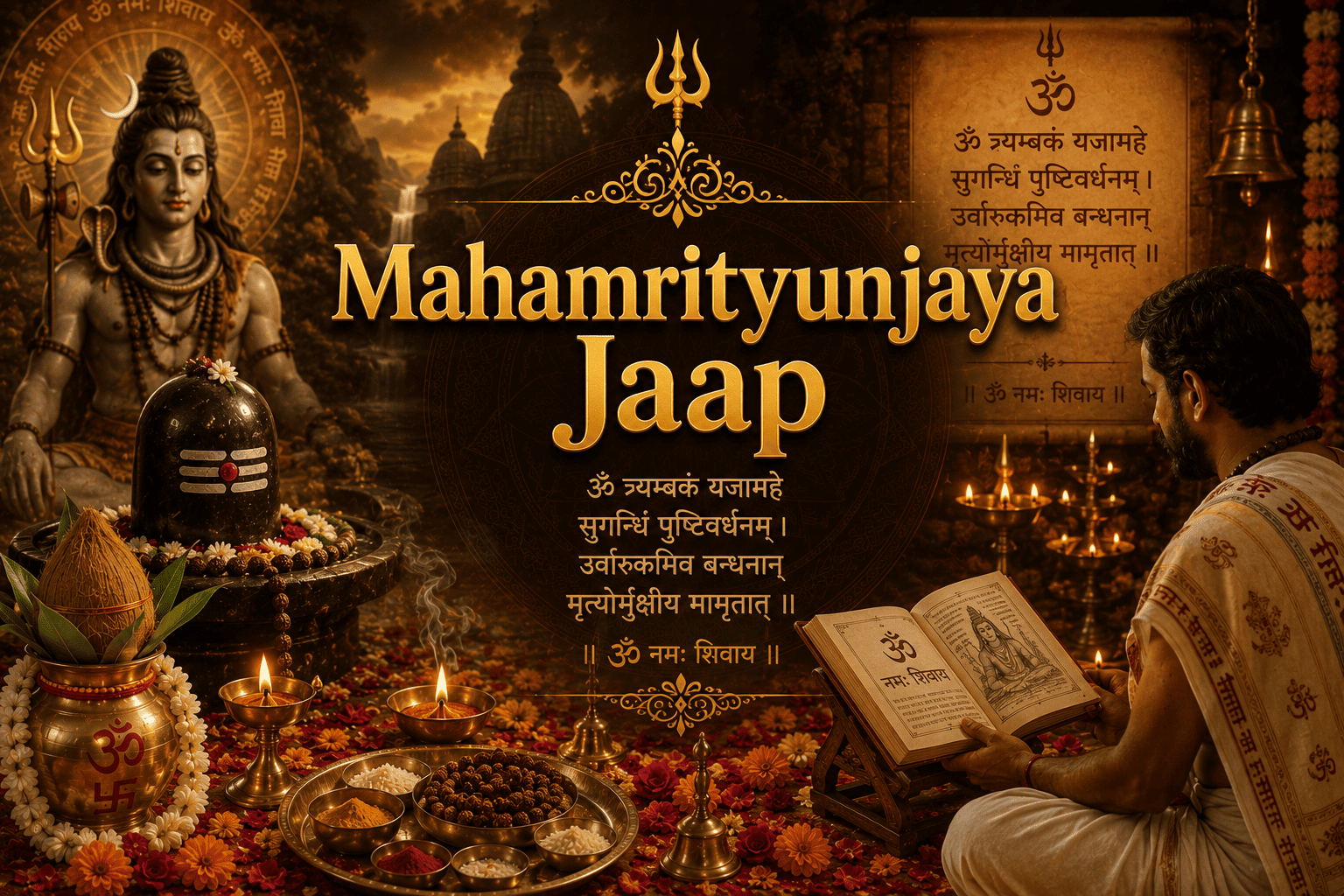
Deconstructing the Sacred Sound: Word-by-Word Meaning Before engaging in any Jaap (mantra recitation), understanding its meaning transforms plain chanting into profound devotion. The mantra invokes the three-eyed Lord Shiva (Tryambaka), who nourishes all living beings like a fragrant garden.
$$\text{ॐ त्र्यम्बकं यजामहे सुगन्धिं पुष्टिवर्धनम् ।}$$$$\text{उर्वारुकमिव बन्धनान्मृत्योर्मुक्षीय माऽमृतात् ॥}$$
Om ($\text{ॐ}$): The primordial cosmic sound of the universe. Tryambakam ($\text{त्र्यम्बकं}$): To the Three-Eyed One (Lord Shiva, whose eyes represent the Sun, Moon, and Fire). Yajamahe ($\text{यजामहे}$): We worship, honor, and adore. Sugandhim ($\text{सुगन्धिं}$): The one who is fragrant with divine virtue and spiritual presence. Pushti-Vardhanam ($\text{पुष्टिवर्धनम्}$): The nourisher of life force, health, and spiritual vitality. Urvarukam-Iva ($\text{उर्वारुकमिव}$): Just like a ripe cucumber easily detaches from its vine. Bandhanan ($\text{बन्धनात्}$): From the bondage of physical pain, disease, and worldly attachment. Mrityor-Mukshiya ($\text{मृत्योर्मुक्षीय}$): Deliver us from premature death, fear, and suffering. Ma 'Amritat ($\text{माऽमृतात्}$): But never separate us from immortality (Moksha) and divine grace. Astrological & Life Triggers: When is the Jaap Essential? While daily chanting brings peace to anyone, a structured Mahamrityunjaya Anushthan (formal multi-day ritual) is specifically prescribed under key circumstances:Severe Health Crises & Chronic Diseases: During critical illness, major surgical procedures, or long-term ailments to accelerate bodily healing. Active Markesh or Rahu-Ketu Dasha: When a birth chart (Kundali) enters the planetary period (Dasha/Antardasha) of Maraka (death-inflicting) planets or heavy Saturn (Shani) transits like Sade Sati. Prevention of Unforeseen Accidents (Akaal Mrityu): Shielding individuals involved in high-risk professions, frequent travels, or facing life-threatening situations. Relief from Deep Depression & Anxiety: Dissolving subconscious fear, insomnia, panic disorders, and emotional paralysis. Removal of Severe Karmic Obstacles: Clearing deep-seated ancestral karmas (Pitri Dosh) and negative environmental energies. Insight from an Acharya: The Mahamrityunjaya Mantra does not challenge the natural cycle of life. Instead, it cleanses the body's subtle energy channels (Nadis), strengthens the aura, and prevents Akaal Mrityu—death or suffering that occurs prematurely due to unresolved negative karmas. The Power of Mantra Counts: Choosing Your AnushthanIn Vedic Karmakand, the total count of recitations (Jaap Sankhya) determines the depth of cosmic resonance generated during the Anushthan:Recitation CountTarget Intent & Spiritual PurposeDuration (With Qualified Priests)11,000 ChantsDaily health protection, mental clarity, and anxiety relief.1 to 3 Days21,000 ChantsOvercoming moderate health issues and resolving ongoing family disputes.3 to 5 Days51,000 ChantsShielding against heavy planetary Dasha (Markesh) and severe illness recovery.5 to 7 Days1,25,000 Chants (Sawa Lakh)The Ultimate Anushthan. Overcoming life-threatening crises, chronic diseases, and achieving complete spiritual liberation.7 to 11 Days Step-by-Step Anushthan & Hawan VidhiA formal Mahamrityunjaya Anushthan must be executed with purity, correct pronunciation (Swar), and disciplined focus. Essential Samagri (Ritual Elements)Main Shrine: Shivlinga (preferably Brass, Parard/Mercury, or Stone), Copper Kalash, Rudraksha rosary (Mala). Offerings: Bilva leaves (Belpatra), Shami leaves, Dhatura fruit/flowers, white lotus, Bhasma (sacred ash), sandal paste. Abhishekam Liquids: Milk, curd, honey, sugar, cow ghee (Panchamrit), Gangajal, sugarcane juice, rose water. Hawan Ingredients: Dry coconut, mango wood (Samidha), Giloy stems, Black sesame, barley, Amrita herbs, pure cow ghee.
1. Purification & Sacred Sankalp:20 Minutes. The devotee (Yajaman) bathes, puts on clean white or unstitched traditional attire, and sits on a woolen mat facing East or North. The Acharya performs Pavitrikaran. Holding Gangajal, red flowers, unbroken rice, and silver coins in their palm, the devotee recites the formal Sankalp—stating their name, gotra, location, and the exact intent (health, longevity, or dosha shanti) of the Jaap.
2. Ganesh Puja & Kalash Sthapana:30 Minutes. Lord Ganesha is invoked to bless the altar and prevent impediments. A copper Kalash filled with holy water, mango leaves, and a coconut wrapped in cloth is established (Varun Puja) to anchor cosmic energy throughout the multi-day ritual.
3. Panchamrit Abhishekam & Shringaar:45 Minutes. The Shivlinga is ritually bathed with raw milk, curd, honey, ghee, sugar, and Gangajal while chanting the Rudra Suktam. Lord Shiva is then adorned with fresh Bhasma, sandalwood paste, Bilva leaves, and Dhatura.
4. Rudra & Jaap Chanting (With Rudraksha Mala):Varies by Count. Priests begin the continuous recitation of the Mahamrityunjaya Mantra using naturally energized Rudraksha beads. Strict silence, purity, and exact phonetic accuracy are maintained. Each round of 108 chants is tracked carefully to reach the targeted count.
5. Dashamsha Hawan (Sacred Fire Ceremony):60 - 90 Minutes. Upon completing the total Jaap count, a Dashamsha Hawan (10% of the total Jaap count) is performed. A consecrated Hawan Kund is lit. Herbal roots like Giloy, black sesame, ghee, and herbs are offered into the fire with each mantra chant ending in "Swaha".
6.
Purnahuti, Tarpan & Marjan:20 Minutes. The grand final offering (Purnahuti) using a dry coconut filled with ghee, herbs, and silks is offered into the holy flames. This is followed by Tarpan (water offerings) and Marjan (sprinkling holy water over the devotee) to seal the divine protection. Best Sacred Destinations for Performing the AnushthanWhile this Jaap can be performed at home in a quiet, clean room or local Shiva temple, certain pilgrimage sites possess immense energy (Siddha Peethas): +-------------------------------------------------------------+ | SACRED SITES FOR MAHAMRITYUNJAYA ANUSHTHAN | +-------------------------------------------------------------+ |
1. Mahakaleshwar Temple, Ujjain (Abode of the Lord of Time) |
|
2. Kashi Vishwanath, Varanasi (City of Moksha) |
|
3. Trimbakeshwar Temple, Nashik (Jyotirlinga Source) |
|
4. Jageshwar Dham, Uttarakhand (Ancient Mrityunjaya Shrine) |
+-------------------------------------------------------------+ Mahakaleshwar Temple (Ujjain, Madhya Pradesh): As the only south-facing (Dakshinmukhi) Jyotirlinga, Lord Mahakal governs time and death directly. Anushthans here offer ultimate protection. Jageshwar Dham (Almora, Uttarakhand): Nestled in dense Deodar forests, this ancient temple complex holds the primary Maha Mrityunjaya shrine established by Adi Shankaracharya. Kashi Vishwanath (Varanasi): Performing the Abhishekam and Jaap on the banks of the holy Ganga in Kashi destroys deep karmic afflictions. Essential Rules for Chanting at HomeIf you wish to chant the Mahamrityunjaya Mantra independently at home, observe these foundational rules:Use a Authentic Rudraksha Mala: Always chant using a clean, 108-bead Rudraksha rosary. Never chant without a bead count or mat (Aasan). Correct Pronunciation: Pronounce each Sanskrit syllable clearly. If the full mantra feels complex initially, begin with the Laghu Mrityunjaya Mantra: "Om Joom Sah (Name) Paalay Paalay Sah Joom Om". Set a Fixed Time & Place: Sit facing North or East during early morning (Brahma Muhurta) or sunset hours in a clean, quiet space. Maintain Sattvic Habits: Abstain from meat, alcohol, and deceitful speech during your daily chanting commitments.